
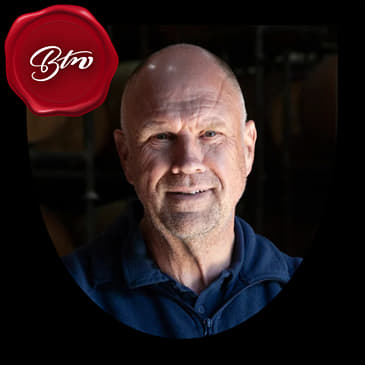
From Pioneer to Provenance: The Passion, Place and Persistence of Robin Brockett.
Today we have the pleasure of welcoming Robin Brockett from Scotchmans Hill Winery. Previously working in the New Zealand wine industry, Robin joined Scotchmans Hill in 1988, as Vineyard Manager. With a degree in Oenology (Winemaking) from Charles Sturt University, Robin took on the responsibilities of Winemaker in 1990.
From the original single label, Scotchmans Hill, the Estate has released a further 11 new labels, including the Swan Bay and Cornelius ranges.
Instrumental in the growth of Scotchmans Hill, and now the Chief Winemaker, Robin has been active in establishing the Bellarine as a thriving wine region.
Robin Brockett was recently inducted into the 2023 Hall of Fame, Geelong Wine Awards.
[00:00:08] Welcome to Behind the Wines, a freshly bottled podcast about Australian wine, the wines we love and the people behind them. My mission is simple. I want to get down into the cellar with sommeliers, stomp some grapes with winemakers and have chats with our finest critics, growers, retailers and chefs. Now today's guest is someone who's been part of Victorian Wine Story for more than three decades.
[00:00:35] Robert Brocken joined Scotchmans Hills in 1988, when the Belnerine Peninsula was still very much a pioneering wine region. With a background in etiology, experience in New Zealand and decades spent making wine on the Belnerine, Robin has played an enormous role in helping establish the region's identity. Today he's Chief Winemaker at Scotchman Hill and in 2023 was inducted into the Geelong Wine Awards Hall of Fame.
[00:01:03] So from pioneering vineyards to cool climate winemaking and to building a wine region, let's go Behind the Wines with Robin Brockett. Julian Langworthy, welcome to Behind the Wines. Great to be here and looking forward to the chat. You grew up in New Zealand and found your way into wine while at university. Yep.
[00:01:29] What was it about winemaking that grabbed you and made you realise this was the career for you? I'm from Christchurch, so I went to Lincoln College to study agricultural finance. Thought I'd get into the rural bank or something like that and after 12 months, first year, I had to work for 12 months full-time in the industry and I wanted to specialise in horticulture and the first vineyard winery had just been planted and the winery was being built
[00:01:57] and I went and saw them, no particular reason, just thought it was interesting. Went there for a year, deferred the second year. There was a winemaker there who sort of took me under his wing and I used to go around Sunday afternoons to his house and, you know, pull out Mouton Rothschild and all these wines and sit there and drink them and as a 19, 20-year-old, they went over my head. But I was just awestruck and that sort of was the bug to really get into it.
[00:02:25] That sounds incredible, like opening the, you know, iconic world wines at such an early age. But do you think that maybe perhaps that shaped your palate, gave you a taste of what wine could be rather than, you know, 19-year-olds buying the cheapest Sauvignon Blanc or something and scoffing that down? Yeah, it certainly did and it made me realise the wine industry was global and everything was about France back then and to add the opportunity to drink those wines and then eventually get to visit some of those estates.
[00:02:55] It was pretty amazing. So you came across the ditch, you joined Scotchman's Hill in 1988. Yep. When the Belmarine was still in the pioneering wine region. What did you see in the region that made you want to stay? When I originally went there, I thought I'd be here two to three years. Being by the sea and reminded me a lot of parts of New Zealand, although there were gum trees and everything like that compared to New Zealand. But being close to the water in New Zealand, you're close to the sea everywhere
[00:03:23] and I just had a feel about it. But it was pioneering days when I started in New Zealand. I think Melbourne had only been going four or five years, the first vines I've been in. So the industry in Australia, apart from those like Barossa and McLaren Vale, was pioneering as well. And I say to people, if you drove around in 1980, 85, around most southern Victorian regions, you wouldn't have found much there. Yeah. And what were you finding there? What was around at that stage?
[00:03:53] Did you just look and say, the geography, the land of terror here is something that looks relatable that I could work with? Yep. And also 10 minutes from a beach. But back then you could get to Melbourne within an hour and a quarter. So you sort of had the best of both worlds where you were living in the country, but you were very close to big cities and so forth. So coming from New Zealand, so you're already familiar with Cool Climate Maritime Wines.
[00:04:20] What does the Bellarine's Maritime Climate bring to its wines? Because we're quite exposed where we are. So we're only 30km across the water to Red Hill. So we're very close, but the wines are very different. We don't have the trees everywhere. We don't have the shelter. So we're very exposed. And that plays a huge part in the fruit. You know, our crops normally are quite low. So the accountant keeps telling me. But they're sort of tougher vines.
[00:04:50] They don't have big canopies like, say, Mornington or Yarra. We get about two-thirds of the rain Mornington gets to half the rain compared to right on top of Red Hill. And we get half the rainfall the Yarra Valley gets. So it's a lot tougher environment, exposed. All aspects, you're getting hammered by the wind, whether it's northerly, southerly. And that really plays a part. Where Scotchmans is, we're on a heavy black clay, high in iron. So similar soil to Red Hill.
[00:05:18] There's just quite a few million years difference in age. They're quite young on our side. And then the rest of the peninsula is sort of sandy. Loam has been underwater multiple times with ice ages. And then when the polar caps are melted, it's gone underwater. So all that has quite an impact as well. And just for listeners out there, how large is Scotchman Hill? We're bigger than anybody on Mornington Peninsula. So we have 270 acres or about 107, 108 hectares.
[00:05:48] I like acres because they sound more impressive than hectares. And we would crush for Scotchmans around 600 tonne on average. So we're around 40,000 cases off the Bellaroon. The Yarra Valley, there'd be maybe three, four people that would be bigger than us. So we're a significant player in the region. And we're double the size of anybody else in the greater Geelong area.
[00:06:14] So you mentioned climate conditions and size as well. What else do you think makes Bellaroon different from regions like the Yarra Valley and the Winterpill? I think one of the main things, the people, that we don't have any corporates and never have in the region. So when you visit and the winemaking as well, everybody's an individual and we're not governed by corporate ideas, any of that.
[00:06:41] And there are a few of us that we're all different people, different personalities. And none of us want to make wine like the other one does. So there's a huge variation in style, not in quality, but more style and how the wines are. And when you go there, you get to meet the people that are actually behind the labels in general rather than, you know, a corporate sort of thing. And so you're saying that you're quite individualized or you're quite independent and got different personalities. But do you find that you're kind of collegiate?
[00:07:09] Probably not as much as say Mornington or Yarra. We know each other and we'll talk and that sort of thing. But yeah, we probably don't get together as much as some of these other regions would. But we all want to see each other succeed because the more we all succeed, the better it is for the region. You describe winemaking as a combination of art and science. Yeah. So how do you balance technical precision with allowing the wine to have personality and soul?
[00:07:39] Yep. So I think all wines should have a personality. There's too much wine in the world that's boring. So it doesn't matter where it is, it should have its own personality. And I was saying to people the other day that quite often you can tell the personality of a winemaker by the wines they make. They're really tight and they take a lot to open up. And then you tend to find that winemakers maybe a bit introverted, quite tight within themselves. And then you find other wines that are over the top.
[00:08:05] And you look at the winemaker and you go, yeah, I can see that coming through. But you've got to get it right in the vineyard. My training originally was viticulture. And my view on the winery, we shouldn't be mucking around. We take a very hands-off approach to winemaking. We shouldn't be having to play around too much in the winery. Really let that fruit express itself. So we have a very hands-off approach, very European.
[00:08:31] Having done some vintages in Europe, we're at very minimal what we do. So reds, apart from maybe having to add a little bit of acid, we add nothing else. The wines are all while fermented, all that. We do no finding. So it really is about that expression of fruit in the vineyard. So you need the science to make sure you're within parameters and you've got balance within the wine and so forth. But really the vineyard's personality should come through foremost.
[00:08:59] I love it how you said that the personality of the winemakers can be expressed in the bottle. Because I do know a lot of different type of winemakers. And I guess, yeah, when you think about it, it seems kind of like a funny concept. But yeah, I can see how you could use your technical experience and use with the conditions that you have to really kind of develop a wine into a style that kind of reflects you. Yeah. And personally myself, I don't want to make wine like everybody else does.
[00:09:25] I don't want my wine to taste like two or three other wineries down the road. So I work very hard to make sure they don't. But the other winemakers in the region, they don't want their wine to look like ours either. So that's why we get such diversity. So after 30 years of vintages, what has winemaking taught you about dealing with difficult seasons and unpredictable conditions? I think to relax and not get too concerned.
[00:09:52] Because at the end of the day, you'll ultimately end up making something pretty good and not get too stressed out what will happen or happen. We've been pretty lucky in the last 15 years that we've had ups and downs with vintages, but we haven't had a bad vintage. So 11 was probably the last challenging vintage we faced, but the whites were extremely good that year. So since 11 to 12 right through to now, crops are up and down.
[00:10:21] We have different quality, but yeah, they're probably in quite a narrow band, the quality we're getting. So back in the 90s, 80s, it'd be like a sawtooth, great vintage, terrible, okay, bad, back up to great. We seem to be more like a nice rolling ocean wave these days. It seems like you're eyeing out the predictability in maybe in the way you structure and the way you deal with your vineyard. Do you foresee that changing with climate change?
[00:10:48] Yeah, one of the things I've done is planted five different varieties, a hectare of each at the vineyard. So we've planted Albarino, Viano, Sangiovese, Gamay and Tempranillo. And we'll add to that, but I planted a hectare so we can actually make a decent volume of wine. And that is for two reasons, partly for climate as it's getting warmer. We are certainly seeing that impact and maybe one day it'll be too warm for Pinot Moir.
[00:11:18] But I don't know, say the Gamay comes into its own or Tempranillo is really showing up well. And it's not just for us, it's for the other winemakers in the region that they'll be able to see how they progress as well. The other thing I think will happen is styles will change. They always evolve, change. Pinot Moirs we make today are very different from 30, 40 years ago. And I think people in 20, 30, 40 years, the style will just be a bit different. And maybe it's a bit bigger, more robust sort of Pinot Moir.
[00:11:47] But people will accept that because it'll just evolve slowly over time. So I'm not worried to a degree where different varieties fall in and out. Wine keeps evolving and I think that'll just be part of the journey. Scotchmans Hill has grown significantly since you've joined from its original single label to a broader portfolio, including Swan Bay and Corneliers. How's the philosophy of the winery involved? When I first went there, I was the only person.
[00:12:16] I now have three winemakers work with me. So Marcus Holt, he's been with me 25 years. Came as a student, worked a couple of intuages overseas, ended up coming back. Peter Armstrong, who'd worked at Domaine Shandon and Luminous State in different places. He came down for a vintage job and then didn't leave. And now I've got a young guy, Lucas Doppler, who's just finishing his winemaking degree.
[00:12:41] And we're sort of mentoring him and all of us to sort of, he'll be the next generation that'll come along. That's had quite an impact just on the development. And the philosophies over time have changed from just making five, six wines to where today we're probably making 40 wines under our label. Yeah. You're now producing handcraft at limited release and micro batches. Yeah. What are you trying to achieve with those wines perhaps that you can't achieve on a larger scale?
[00:13:10] We partly use it to showcase the best of the best of the vineyard and our talents. But also a lot of stuff we learn making those wines that over time filter down into the other ones. So that were the first wines where we did a lot of wild ferments, wild monolactics, all that. And once we perfected it there, it sort of filtered down to where any wine that goes to barrel, whether white or reds or wild fermented, wild monolactics, so forth.
[00:13:38] So all that has an impact and we learn a lot from that. After making wines for more than three decades, what do you notice in the vineyard or vintage today that you might have missed when you're starting out? That's a good question. I think experience plays a lot where you do things, you might make mistakes or things that happen and you wouldn't really know why.
[00:14:01] Now, because you've got that bank of history, you can go, oh, well, that reminds me of that year and we had that problem or that problem. So you can react to it or let's be aware this could be an issue down the track. So that experience and really learning when you're young, you tend to go bullet a gate and sometimes you make mistakes and quite often you don't know why. But as you do it for a long time, you still learn and that knowledge builds up that really helps.
[00:14:30] And, you know, I think I'm making the best wines I've made now, not what I was doing back 30, 40 years ago. I think the common theme I've heard in my podcast is that winemakers always want to make the best next wine. Yeah. And speaking of that, in 2023, you were inducted into the Geelong Wine Awards Hall of Fame. Yeah. What did that recognition mean to you? It was quite humbling actually and quite a shock.
[00:14:57] And I'm not normally caught for words, but when I was presented, I was sort of dumbfounded. It was great recognition. And I've helped a lot of people on the way and a lot of the people in the industry are friends. And to have that recognition was very special. You also helped and encouraged many of the newer producers coming into the region. How important is collaboration to building successful wine region? I think it's extremely important.
[00:15:25] There's no point having a star winery and everybody else is struggling. That doesn't help the region. The stronger and the better each individual is, the better the whole collective. And it brings more people, more recognition. More people are going to go out to restaurants, bottle shops, buy Ballerine wine. And that's really important. Rather than just having a brand, you need to have that region behind you.
[00:15:49] And so looking at the Ballerine today, what makes you most proud and what do you think the region still has to achieve? Probably when we started, we were the only ones initially and the first cellar door, that sort of thing. I think having that collective has really established the Ballerine. Back 30 years ago, people had known, say, Scotchman's Hill. And quite often they thought we were on Morningfin Peninsula.
[00:16:16] Today, the region really stands alone and I think still under-recognised. I think the quality of the lines are as equal as anywhere in southern Victoria. And so finally, if you could give the young Robin, just starting out in winemaking, one piece of vice, what would it be? To be brave and not be worried about if a wine doesn't quite work out, you'll learn from it.
[00:16:43] And from that learning, you'll make better and better wine over time. Robin, that's taken us from your first taste of the wine industry right through to helping shape one of Victoria's emerging wine regions. But before we let you go, it's time to put the serious winemaking questions aside and find a little bit more about the man behind the bottle. It's time for half glass full. Yep. Quickfire questions, short answers, no overthinking. You ready for it? First wine that made you think, wow.
[00:17:11] A 67 Mouton Rothschild. New Zealand or Australia for wine? I think they both offer great things. I'd have to say Australia just because that's where I'm based. Your favourite Ballerine variety? Pinot Moir. The wine you could drink for the rest of your life? I'd be Pinot Moir. Best wine you've ever had? Probably one that brings back memories.
[00:17:41] It was a 94, gone blank, John Groh from Vaughan Romany. That blew me away. Favourite wine region outside the Ballerine? Burgundy. Most underrated grape variety? Pinot Gris. Best vintage you've ever worked? There have been a number of them, but probably 17.
[00:18:09] Long lunch or a long bike ride? I like bike ride. Best food match for a Ballerine wine? I think because I'm a Kiwi, I think seafood really goes well. Mussels and oysters and so forth. If you weren't a winemaker, what would you be doing? Well, I know what I'd love to do and that'd be a professional golfer, but that's not going to happen.
[00:18:36] I'd probably be tied up in agriculture somewhere, but more on the financial side. Well, I hope you're still working on your handicap. Yeah. The best thing about living on the Ballerine? I think it's a very slow sort of lifestyle compared to most other areas. Proximity to the beaches, but also to major city. If you can finish this sentence, a great wine should always... Be made in the vineyard.
[00:19:01] And after 30 years of making wine, is your glass half full, half empty, or do you just keep topping it up? Keep topping it up. Robin, you've given us plenty to think about and hopefully a few wines to think about as well. It's been a real pleasure hearing your journey, your philosophy, and your passion for the Ballerine, and getting a glimpse behind the wines that have helped put this region on the map. So thanks for joining me today on Behind the Wines. It's been fun. Thank you. And a special thanks goes to you, our listeners.
[00:19:31] And if you've enjoyed this episode, please subscribe to the podcast, leave a review, and share with your family, friends, and fellow wine lovers. And don't forget to visit our website for exclusive offers and the special wine tastings at Leroy in Bay Street Brighton, for those you'll not want to miss. And as always, a big thank you to Prue, Mark, and Pierre for making this podcast possible, and an acknowledgement to the traditional custodians, the land of the Wondry people, where this podcast is produced.
[00:19:59] So until next time, stay curious, drink well, and keep your glass half full. Cheers!